How much time do you save by quitting weed?

If you spent two hours a day high, quitting weed gives you back 14 hours a week, about 60 hours a month and around 730 hours a year. That's roughly 30 full days. Your exact number depends on how much of your day smoking took up, but for daily users it's usually more time than they expect.
How to calculate the time you'll save
Count the hours you were actually high or busy with weed on a normal day: buying, rolling, smoking, and the stretch afterwards when you weren't going to do much else. Multiply by seven for a week.
- 1 hour a day = 7 hours a week, about 365 hours a year
- 2 hours a day = 14 hours a week, about 730 hours a year
- 4 hours a day = 28 hours a week, about 1,460 hours a year
Be honest but not harsh. Not every high hour was wasted, and guilt isn't the goal. The goal is to see what's now available to you.
Money saved vs time saved
Most quit trackers show money saved, and that number matters. But money stays abstract until you spend it. Time is easier to feel. Fourteen hours this week is a free Saturday morning, an evening class, a long call with your brother.
Seeing hours also helps on rough days. "I've reclaimed 140 hours" is a more motivating thought than "I haven't smoked in 30 days", because it's about what you gained.
The hidden hours weed was taking
The hours spent high are only part of it. Plenty of people also lose time to the slow, foggy mornings after a heavy night, to planning around when and where they can smoke, and to trips to buy more. None of that shows up in a simple hours-per-day estimate.
Many people also notice they get more done in the hours they already had. Focus at work tends to improve over the first month, and tasks that used to drag on all evening take half the time. That's harder to measure, but it's often what people mention first when asked what changed.
What to do with the hours you get back
Unplanned free time tends to drift back towards old habits, so give some of it a job. A few ideas from people who've done it:
- Pick up something you dropped years ago: an instrument, a sport, drawing.
- Cook properly a few nights a week instead of ordering in.
- Book a fixed weekly slot with a friend.
- Catch up on sleep. Early on, some of the time is best spent resting.
When the evenings feel empty rather than free, the guide on boredom after quitting weed has a list sorted by energy level.
How Foglift tracks time reclaimed
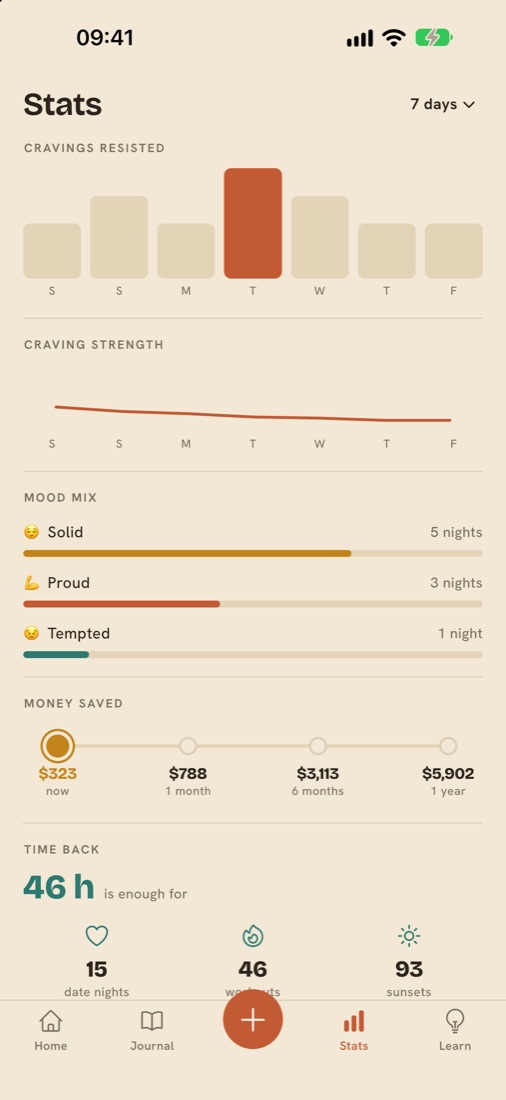
During setup you tell Foglift roughly how often you smoke and how much time it takes. From your quit date it counts the hours you've won back and shows them on the home screen.
You can also add hobbies and assign hours to them, so 140 hours turns into 11 hours of football, 5 hours of cooking and 14 hours with friends. The time stops being a number and becomes a list of things you actually did.
More questions
Is time saved a better motivator than money saved?
For many people, yes, because hours are easier to picture. Tracking both works best, so you can lean on whichever one keeps you going on a given day.
Does it count if I just sleep more?
Sure. Better sleep is one of the main benefits of quitting, and catching up on rest in the first weeks is a good use of the time.